Five Science Projects That Are Cooler Than Making Slime
Science projects have the power to ignite curiosity, spark creativity, and bring out the inner scientist in all of us. While making slime has become a popular activity, there are countless other scien...
Science projects have the power to ignite curiosity, spark creativity, and bring out the inner scientist in all of us. While making slime has become a popular activity, there are countless other science projects that are even cooler and offer a broader range of educational and experiential benefits. Today, we’re going to spice things up and look at five science projects that go beyond slime-making, offering exciting and engaging experiences for young scientists and curious minds.
1. DIY Solar-Powered Oven
Forget about traditional baking methods—building a solar-powered oven is a science project that will truly impress. Using simple materials like cardboard, aluminum foil, and a sheet of glass or plastic, you can construct an oven that uses solar energy to heat and cook food. This project not only demonstrates the power of renewable energy but also teaches principles of heat transfer and energy conversion. By observing the effects of sunlight on temperature and cooking times, young scientists can gain insights into solar energy's practical applications and explore concepts like insulation, reflection, and absorption. They can experiment with different designs and materials to optimize the oven's efficiency and learn about sustainability and environmental conservation along the way.
2. Growing Crystals
If you're looking for a visually stunning science project, growing crystals is the way to go. With some basic household items and a supersaturated solution, you can create beautiful crystal formations right in your own home. This project allows budding scientists to explore the principles of solubility, saturation, and crystal formation, while also developing patience and observation skills. The process of growing crystals involves creating a saturated solution by dissolving a solute (such as salt, sugar, or Epsom salt) in a liquid (usually water) and allowing it to slowly cool or evaporate. As the solution cools, crystals form and grow over time.
3. Homemade Hovercraft
Who wouldn't want to glide effortlessly on a cushion of air? Building a homemade hovercraft is a science project that combines principles of physics, engineering, and aerodynamics. Using everyday materials like a CD, a balloon, and a bottle cap, you can create a small hovercraft that hovers above a smooth surface. This project allows young scientists to explore the concept of air pressure and how it can be harnessed for propulsion. By inflating the balloon and releasing air through the bottle cap's nozzle, the hovercraft creates a layer of trapped air that reduces friction and allows it to move smoothly. Experimenting with different designs and variables like balloon size or surface type provides opportunities to learn about lift, thrust, and how forces interact in motion.
4. DIY Volcano Eruption
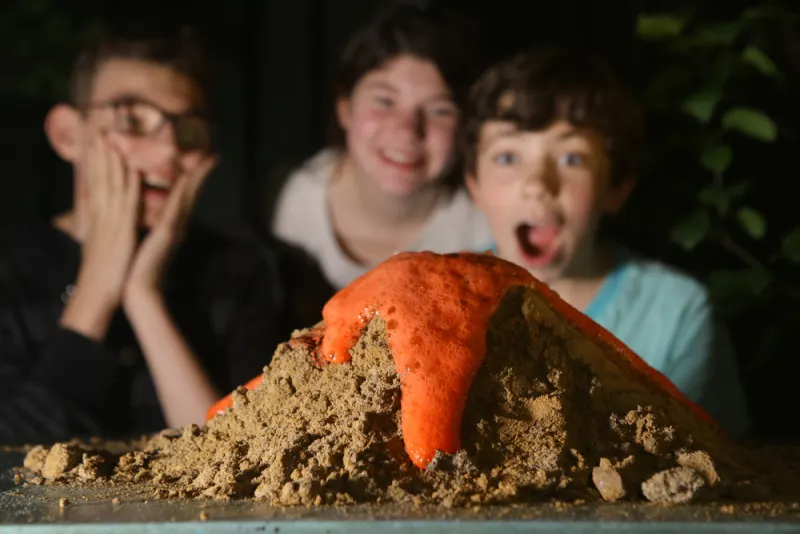
The classic volcano experiment never gets old. By creating a homemade volcano using materials like baking soda, vinegar, and a bottle, you can simulate a volcanic eruption right in your backyard. This project allows young scientists to explore chemical reactions, gas formation, and the principles of pressure and eruption. By combining baking soda and vinegar, a chemical reaction occurs that releases carbon dioxide gas. This gas builds up pressure within the bottle and eventually erupts, mimicking the explosive force of a volcanic eruption.
5. Paper Airplane Aerodynamics
Unleash your inner aviator and dive into the fascinating world of paper airplane aerodynamics. By experimenting with different paper airplane designs, wing shapes, and folds, you can investigate the principles of flight, lift, and drag. This project not only encourages creativity and fine motor skills but also introduces scientific concepts in a fun and accessible way. Through trial and error, young scientists can observe how altering factors like wing shape, weight distribution, and the angle of the wings affects flight performance. They can test their planes' stability, distance, and ability to perform tricks, all while learning about the basic principles of aerodynamics. This project can be expanded upon by researching advanced aircraft designs and exploring the principles behind real-world airplanes.